The Second Generation’s Double Displacement and Search for Belonging
And Their Children After ThemThe Second Generation’s Double Displacement and Search for Belonging names the tension between immigrant fathers’ efforts to establish a life in France and their sons’ sense that neither the fathers’ old world nor French society fully makes room for them. The novel presents that tension not as a simple rejection of family or a single explanation for failure, but as an inheritance shaped by work, language, social rank, and the uncertain possibility of belonging. Hacine’s experience gives the divide an intimate form: he feels distant from the older men around him, yet remains bound to his father, whose care and eventual absence continue to define what Hacine fears he has inherited.
Fathers, Work, and an Unfinished Welcome
At the funeral gathering for Luc Grandemange, Patrick Casati encounters Malek Bouali, a former colleague from the mill. They had worked at neighboring stations before Patrick was assigned to the pour, and their reunion briefly restores the familiarity of shared work and youth. Their conversation turns to health, children, and family, then to the old colleagues they might gather with one day. But the reunion is also marked by the cost of the lives they have lived: Patrick notes that Bouali worked extremely hard and is now disabled, with only a small pension. The work that once connected them has not secured an untroubled old age.
Patrick’s remarks make the fathers’ position complicated rather than merely pitiable. He speaks of immigrant workers as people who worked harder than anyone, while also describing their children harshly. Anthony reacts to that reference with a knot of anxiety and avoids looking at Hélène. The exchange shows that the distance between generations is present even inside a family conversation: adult judgments about the sons can expose an unease the sons cannot easily voice. At the same gathering, about a dozen older Maghreb immigrants sit together, drinking Picon and speaking among themselves rather than in French; their wives have stayed home, and the surrounding crowd pays them little attention. Their attendance registers an effort to participate, but not a guarantee of being included.
Respect Without Identification
Hacine’s discomfort among the older men makes the generational conflict explicit. He would rather leave, but gives in and orders a Coke. He regards the men as having been born elsewhere and as holding naïve ideas; at the same time, the account explains why their sons cannot simply dismiss them. The boys grew up fearing fathers who imposed firm rules, yet could not take those rules fully seriously. The fathers spoke French badly, misunderstood the workings of French society, and passed on precepts their sons experienced as out of date. Respect and contempt therefore coexist, leaving the sons caught between obligations to their fathers and doubts about the authority of what the fathers teach.
The material record does not settle the question. The fathers escaped some of the poverty they had known: they own cars and color televisions, have roofs over their heads, and send their children to school. Yet those achievements do not make them successful in any complete sense. Poorly paid work, occupational marginalization, disrespect, and the category of immigrant continue to mark their place in society. The account also describes them as suspended between languages and shores, with no secure heritage to pass on. Their sons inherit not simply poverty, but disappointment: the sense that effort and modest security have not yielded a recognized place or a legacy that can be carried forward.
Structural Barriers and Personal Choice
That inheritance bears on education and ambition. Doing well at school, building a career, and accepting the rules of success can seem almost impossible when one’s family is treated as a minor footnote to society; even honest effort may feel like collaboration with a system that marginalizes them. But the novel does not make circumstance a complete explanation. Hacine knows former classmates who have earned technical diplomas, studied sociology or mechanical engineering, gained business certificates, or gone on to study medicine. Their paths complicate any claim that the sons’ prospects are wholly predetermined by their background.
Hacine himself tends to favor explanations that excuse him and justify his lawbreaking. This self-awareness prevents social critique from becoming a simple acquittal: exclusion shapes the field in which he acts, but he also makes choices within it. The contrast between the classmates’ varied educational paths and Hacine’s self-justifying account leaves the causes unresolved among circumstance, personal laziness, and broader oppression. The uncertainty is part of the concept’s force. The inherited disadvantage is real, but the novel does not erase individual agency or pretend that every outcome can be assigned to one cause.
Hacine, His Father, and the Search for Home
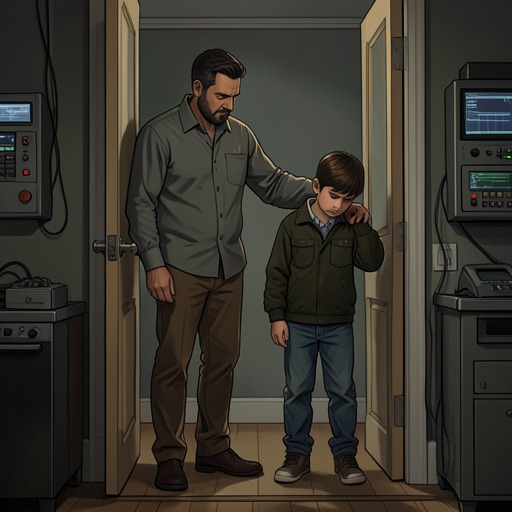
The generational divide continues after Hacine’s life appears to settle. He has lost his teeth and, after the violence that left him hospitalized, has stopped making waves. His father knelt beside him and visited him every day in hospital; after the trial, Bouali returned to Morocco, this time for good. Their care for one another is therefore genuine, but it does not produce lasting closeness. Hacine’s telephone calls now bring the voice of a man he experiences as a stranger, gradually disappearing from his life. He has promised himself for months that he will visit, yet fears meeting what he imagines as a ghost. The father’s distance turns inheritance into something both desired and feared: Hacine wants a connection, but anticipates only the pain of finding it nearly gone.
Coralie helps him manage that loneliness, while their household offers a limited, everyday form of belonging. Their apartment on the heights has concrete courtyards, gas heat, double glazing, and shared spaces that still smell new; from its window Hacine can see Heillange and as far as Guérémange. The practical comforts and the view do not make him feel at home. Looking down at families gathered on a Sunday prompts a larger unease, even as Coralie’s presence reassures him. The contrast is central: a settled address, domestic routines, and a partner can make life more bearable without resolving the older dislocation. Hacine’s search for belonging remains suspended between a father he may not be able to recover, a society in which his family has been kept at the margins, and the fragile intimacy he has built for himself.